Imagine this. You’re nineteen years old, heading out at one in the morning on a Friday night. You haven’t seen your parents in months. They left for Lviv when the war started and you stayed. You’ve been hiding out in an abandoned apartment with two friends, an art student named Yulia and a kid from your neighborhood named Mykola who used to fix bikes. The radiator hasn’t worked since November. You sleep with your boots on. You eat what you can find.
But sleeping through the night is out of the question. These last few months, you haven’t been thinking about your exams or your job. Those things are irrelevant now. You used to want to be an engineer. You used to want a small apartment with a window over a courtyard. None of that matters now. It’s another night in Kyiv, and you’re still here.
Maybe you’ll get a few minutes of shut-eye before leaving tonight. You hang your head way back over the couch and stare up through an open patch of broken concrete and exposed rebar. Missiles and drones dart across the sky like insects over a still pond. Some of them are theirs. Some of them are yours. You’ve gotten good at telling the difference by sound. Exhaustion starts to settle in just as your friends shake you awake. Don’t give in. Not here.
Your head goes dizzy as you get off the couch. One strong breath. You grab your walkie and your rifle. It’s time to go. No time for nerves.
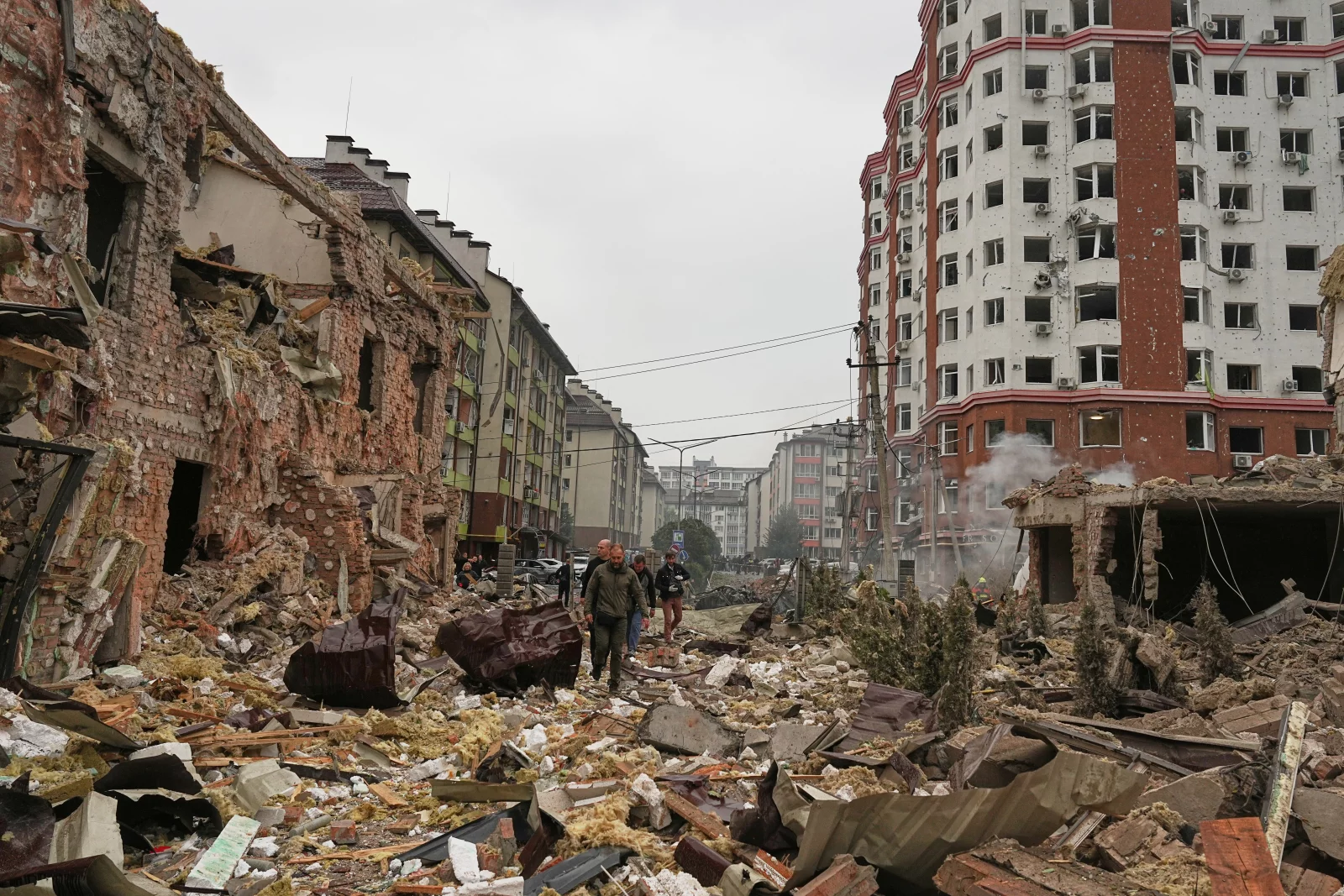
You stalk through rows of fallen buildings. The barbershop where you learned your first pickup line is nothing but blackened rock and little piles of melted glass. The bakery your grandmother loved is a hole. The school you went to until you were twelve has half a wall standing.
There can be no words. Just the popping of rounds and the hum of drones in the distance.
Knees near your chest and fingertips to the ground, you cross intersections and clearings. Your friend up ahead waves you in. There’s a mortar hole leading into an old bank. You go in one by one, down and down.
The popping fades as you get deeper. In its place the pounding gets louder. Steady. Low. The pounding comes at one hundred and thirty beats a minute. Right in sync with your chest.
You find the door at the bottom of the dusty stairs. Inside, you’re hit by a wall of humidity. A hundred bare chests and dirty faces dance in flashing lights to deafening, pounding bass and rhythm. The room smells of sweat and cigarettes and concrete and something burnt. There’s a girl with a shaved head dancing on a speaker stack. There’s a man in his fifties dancing with his eyes closed and his hands in the air. There’s a kid you went to school with who you thought was dead. He’s here. He’s dancing.
You might not see tomorrow night. But you’re here right now.
You check your rifle at the door, and you go in.
It is happening in Gaza. It is happening in Tbilisi. It is happening in Tehran tonight, in basements with the windows blacked out. It’s happening in Beirut. It is happening in Caracas. It is happening in basements in Mexico City. It is happening, this week, on a Friday night, in a thousand rooms in a hundred cities where the world outside has gone wrong.
Why this? Why now? Why, in the places where people are most likely to die in their twenties, do they spend the time they have left dancing in dark rooms with strangers to a four-on-the-floor kick drum?
Unfortunately, you can’t quite get the answer without the experience. But this isn’t a new phenomenon.
It begins on a Monday morning in July, in 1945, in a stretch of New Mexico desert that the Spanish had named the Jornada del Muerto, the Journey of the Dead Man.
A small group of physicists had been working in secret for three years. They had built a device they called the Gadget. They put it on top of a hundred-foot steel tower. They retreated to bunkers ten kilometers away. At 5:29 in the morning, just before sunrise, they detonated it.
Flash.
Ten million degrees. Hotter than the sun. The fireball reached four hundred meters across in about a second. The light was visible from three states away.
One of the witnesses, a physicist named Robert Serber, said the sun came up tremendous.
Twenty-one days later they used a smaller version of the same device over Hiroshima. Three days after that, over Nagasaki. By the end of August, a war that had killed sixty million people was over.
A different kind of war had just begun.
For the next five decades, two governments stared at each other across an ocean with weapons capable of ending civilization and all life on Earth. Their disagreements were communicated through proxies in Korea, Hungary, Cuba, Vietnam, Afghanistan, the moon. By 1960 the American arsenal alone exceeded eighteen thousand warheads. The Soviets matched. The Doomsday Clock sat at three minutes to midnight in 1984. American children practiced ducking under their desks. Soviet children too.
Two generations grew up assuming the species could end on any given Tuesday.
We are Einstein’s monsters, not fully human, not for now. Martin Amis, 1987
In the early hours of August 13, 1961, East German troops laid one hundred and fifty-six kilometers of barbed wire along the inner border of West Berlin in a single shift. The concrete walls came later. The death strip, the watchtowers, the dog runs came over the following months and years. The Wall stood for twenty-eight years. It existed because another European war was no longer tenable. The bomb had made it unfightable. So the pressure had to find another medium, and the medium it found was concrete.
For twenty-eight years, the people on the eastern side of the Wall lived inside the bomb. They could not say so directly. The Stasi had ninety-one thousand official employees and a hundred and seventy-three thousand informants in a country of sixteen million. One officer per a hundred and sixty-six citizens. One snitch per six and a half. By the late 1980s, East Berlin was probably the most thoroughly observed human environment ever constructed. Half your friends were filing reports on you, and you did the same to them.
When the Wall came down on the night of November 9, 1989, what was released was not just freedom of movement. It was the pressure of forty years of being watched. Forty years of being told what to think, what to read, what to want. Forty years of fear so ambient it had stopped being noticeable. And it released all at once.
A government spokesman named Günter Schabowski was reading a press release he had not been briefed on. An Italian reporter asked him when the new travel rules would take effect. Schabowski hesitated, looked at his papers, and said the words that translate as as far as I know, immediately, without delay. He had misread the date. By midnight there were ten thousand people at the checkpoints. By midnight one Stasi officer, alone in a command booth at Bornholmer Strasse, was given the choice between firing on his own population and lifting the gate.
He lifted it.
The people who were there have spent the rest of their lives trying to describe it and have mostly given up.
For roughly two years, large stretches of central East Berlin had no functioning government, no clear property law, and an enormous quantity of empty real estate. The state had simply vanished. The country was being dissolved by treaty. Property records were locked in offices nobody could find the keys to. You could open a door and live there. You could open a door and throw a party there. You could open a door and discover that the room you had just walked into had been waiting for you for forty years.
The bodies that walked through those doors had spent their entire lives being told, by the air they breathed, that the world might end before they got the chance to live in it.
For the first time in any of their lives, nobody was telling them anything.
So, they danced.
They danced for ten hours. They danced for twenty hours. They danced from Friday night through Monday morning. They danced in basements that had survived the war and the partition. They danced in defunct factories, in power stations, in the bank vault of a Wertheim department store that had been Aryanized in 1937, bombed in 1944, sealed inside the death strip in 1961, and forgotten until three friends opened a door in late 1990 and found it whole.
They opened the vault as a club on March 13, 1991, and called it Tresor.
Tanith, who was the resident DJ at Tresor in those first months, has tried more than once to describe the room. The walls were over a meter thick, he said years later. Nothing got through them. The world could have ended, an atomic bomb could have been dropped, and you’d still be partying down there. He was not speaking metaphorically. The vault had survived an actual bombing in 1944. The dancers in 1991 were dancing inside the only kind of room a generation raised under the bomb could fully relax in. A room that the bomb had already failed to destroy.
The drug was ecstasy. The music was a kick drum. The aesthetic was no aesthetic. The clothing was whatever you slept in. The room was always dark and always hot and always full. There was no audience and no performer. There was just the body, and the drum, and the next body, and the next body, until the room became one thing.
Maybe so many people came after the Wall fell because everything around them was changing. Techno was the hope for, and had the power for, identifying with a different world. Cosmic Baby
The kids dancing in those vaults were figuring out, in real time, what unmonitored joy was for.
This was not punk. Punk had been the previous generation, and punk had said: the species is going to end, so I will end myself first, in front of you, in a way you cannot ignore.
What was happening in the basements of post-Wall Berlin was a celebration of having survived. It was the body refusing to perform its own ending. It was a culture about freedom and expression and joy in a city that had been told for forty years that none of those things were available, and that suddenly discovered they had been available the whole time. The kick drum was a metronome that said, every half-second: we are still here.
The kids in the Berlin basements said: keep me alive for ten more minutes, and then ten more, and then ten more.
We’d go into a warehouse to play, and it still looked like a warzone. We were all looking to these futuristic, experimental sounds as an escape vehicle, as a spaceship with which to get away. Robert Hood
Through the 1990s, techno became a global music. By the 2000s, in the cities that had stabilized, it had thinned into a lifestyle. The clubs survived but the urgency did not. In Berlin, in London, in Brooklyn, in Tokyo, the dancers had jobs and leases and brunch reservations, and the kick drum had become decor. Just another thrill for any given Friday.
Existing, available for when we need it most.
And, we need it now as much as ever.
In Tehran, the parties were already underground long before this year. They had been happening for two decades, in private villas in the hills outside the city, in basements with the windows blacked out, in locations chosen for sound containment, organized through encrypted messaging. The punishment for being caught was lashes or prison. None of it stopped them.
On February 28, 2026, the United States and Israel began coordinated airstrikes on Iran. Military and government sites were hit. So were residential buildings. The Supreme Leader, Ali Khamenei, was killed in the first wave, alongside several other senior officials. By the second week of March, the Iranian Red Crescent reported over six thousand civilian targets struck, including five thousand residential units, fourteen medical centers, and sixty-five schools. A group of families who had gathered in Tehran’s Niloofar Square to break their Ramadan fast were killed in a strike on the square. A school in the same square was hit days later. By April 8, a conditional ceasefire was declared. As of May, negotiations remain deadlocked. The Strait of Hormuz remains effectively closed. The Hezbollah-Israel front has metastasized into a separate war in Lebanon that has killed over two thousand more.
The kids who used to drive into the hills for the parties are now driving past blocks where the buildings are gone.
In Tbilisi, on the night of May 12, 2018, Georgian Special Forces walked down a concrete ramp under the Boris Paichadze Dinamo Arena and into a drained Soviet swimming pool, where fifteen hundred people were dancing inside a club called Bassiani. By the next evening, four thousand kids had assembled outside the parliament building on Rustaveli Avenue with mobile sound systems, and they did not leave for two days. The president of Georgia called it a near civil war. The prime minister resigned. The kids had not come to overthrow anything. They had come to keep dancing. The state mistook the dancing for an attack, because at some level the state was right. Six years later, when the ruling party introduced a Russian-style foreign-agents law, Bassiani’s response on Instagram was a single sentence: No to the Russian law against people.
In Ramallah, in 2018, a Palestinian DJ named Sama’ Abdulhadi recorded a Boiler Room set that has been watched on YouTube over eleven million times. In December 2020, she was arrested by the Palestinian Authority police after a livestreamed performance in the courtyard of a hostel attached to a West Bank shrine, and held in a Jericho jail for eight days. In an interview, she said: as a Palestinian, you know life could be over in 10 minutes.
On the night of October 6, 2023, in a clearing five kilometers from the Gaza border, near a kibbutz called Re’im, a trance festival began its second night under the stars. About thirty-five hundred people had come, most of them Israeli, most in their twenties, most there for the sunrise.
At 6:29 the next morning, the first rocket fire from Gaza was visible in the sky. By the time the festival site was secured, three hundred and seventy-eight people had been killed. They had thought they were at another Friday. The Friday turned out to be the end of the world.
In Kyiv, the rave never stopped. Russia’s invasion is in its fourth year. The country’s main techno club, K41, sits inside a former brewery in Podil and is also called by the symbol ∄, the mathematical glyph for does not exist. Closer, a few blocks away in a former ribbon factory, reopened eight months after the invasion and has run events almost every weekend since. Cxema, the roving daytime rave series founded in 2014 by a man named Slava Lepsheiev, never went away.
Curfew is at midnight. So the parties run from one in the afternoon to eleven at night, and the strange sight in Podil on a Saturday is a queue of fetish-geared kids on a sidewalk in broad daylight at three PM. By midnight everyone has to be home. Air-raid sirens cut through sets. Sometimes the floor empties into a basement shelter for an hour, then the music starts again where it left off.
Lepsheiev, who lived through the Maidan revolution before he ever threw a Cxema party, has been clear about what changed in February of 2022. After the full-scale invasion, the vector of resistance changed, he said in an interview in March of this year. It is now directed against the enemy. We get together and dance to stay strong.
In Kharkiv, where the front is closer and the missile alerts are more frequent, a club called Some People runs evening parties between Russian strikes. Anton Nazarko, who co-founded it during the war, said, In the morning, friends from our community are fighting in the trenches. And in the evening, they come to our party. They’re dancing like it’s their last day.
A Kyiv DJ named Daniel, who went by the stage name Detcom, joined the army the week the invasion began and is now a junior sergeant. I didn’t think about that like it was an option or choice, he said. It just felt right. When he comes back from rotation he goes to the same clubs he used to play. Sometimes the DJs in the lineup are soldiers home for the weekend. Sometimes they go back to the front when the set is over. The club has raised something close to eight hundred thousand euros for trucks and drone parts and thermal scopes. The thirty-two-year-old woman dancing next to you in the strobe might be the one who couriered the money to a brigade outside Kupiansk last week.
Look at what we have. A body, a kick drum, a room with no windows, a few hours of darkness.
What is it all for?
The ecstatic truth is this. The human animal is the only animal that has been told it can all end on demand. The human animal has been told this since 1945, and the human animal has not figured out what to do with the information. Most of what the human animal calls civilization, in the years since 1945, has been a slow, polite, increasingly hollow attempt to pretend the information was never received.
Is it that we’re participating in some profound ritual born from the ashes and anxieties of the twentieth century? Are we seeking some kind of proof that humanity’s true nature is not just to survive the threat of our own flaws and self-destruction, but to seek out profound ecstatic joy in spite of it?
We are our own ecstasy and retribution. We fight and build and love and dance and destroy, and we fat ourselves for maggots.
So, you give in. The bass lands in your chest. The girl on the speaker stack catches your eye and smiles. A stranger pulls you into the crowd. Your friends are somewhere in the room. Your rifle is by the door. The night will be over by ten in the morning. You will sneak back through the rubble. You will eat whatever you can find.
You might not see tomorrow. But you’re here right now.