
The screen had a burn mark in the lower left corner, a brownish smear that showed up worst during bright scenes. The speaker clipped to the driver-side hand-cranked window. A gravel lot, eighty cars out of a possible two hundred, their headlights killed, their windshields catching the flicker of whatever Paramount had shipped to central New Jersey that week in a flat metal canister. You could smell popcorn from the concession stand, which was a plywood shack with a single bulb. You could smell cut grass from the field next door. You could smell, if you were close enough to the person in the passenger seat, the dime-store perfume or the Brylcreem or whatever it was that a seventeen-year-old in 1957 put on when they wanted to seem like someone who had been alive longer than seventeen years.
The first kiss happened during the second act. Neither of them would remember the title of the movie three weeks later, though the boy would remember the way the light from the screen moved across the roof of the car in slow blue waves, and the girl would remember that the speaker had been broken and she hadn’t cared, and they would both remember the way the night air sat on their skin, carrying the sound of other car radios through closed windows like music from a party in another room.
Here is what neither of them thought about: the movie was selected by a studio executive in Burbank who approved the project based on audience testing data. It was distributed through a network of regional exchanges that determined which films played in which markets. It was projected onto a screen that existed because a man named Richard Hollingshead had filed U.S. Patent 1,909,537 in 1933 after testing projection angles in his driveway with a Kodak projector balanced on the hood of his car. The drive-in was one of four thousand in the country. All of them were designed, whether their operators articulated it this way or not, to deliver what those audiences believed and wanted and feared.
The evening happened inside the machine.
And the evening was perfect anyway.
Seventeen thousand years before that Friday night, someone crawled into a cave at Lascaux, in the Dordogne Valley of what is now southwestern France, and painted a horse. The cave is deep, remote, clearly not a living space. The painter would’ve needed a stone lamp to see. Nearly two thousand figures cover the walls, some six feet tall, rendered in red and yellow and black pigments blown from the mouth or through hollow tubes. Some images are painted over earlier ones, which could suggest that the act of painting mattered more than the finished result.
Nobody knows why the paintings are there. What none of the theories dispute is that someone, seventeen millennia ago, in a dark space, with pigment and breath, felt the need to make the inside of their head visible on a wall.
The anthropological argument is that this need is biological. Storytelling around fires is how early humans processed danger, transmitted survival knowledge, and built the group identity that made cooperation possible. The original theater. The audience, sitting in the dark, faces lit by moving light, experiencing something together that they could not experience alone, is the same audience that sat in the Colosseum and listened to the radio and scrolled through the feed.
Homer, whoever Homer was, performed the Iliad in an arrangement that looks, from a sufficient distance, like a content distribution deal. The poet travels to the court. The court provides food, shelter, an audience. The poet performs a story that glorifies the lineage of the host. A man with a lyre, firelight, and an audience that could not read, performing a narrative whose content was shaped entirely by the economic relationship between performer and patron.
The Romans took the poetry and replaced it with policy. Juvenal, writing around 100 AD, described what had happened in two Latin words: panem et circenses. That’s bread and circuses. By the fourth century, Rome had 175 public holidays per year. The Colosseum held 50,000 to 80,000 spectators. Gladiatorial combat, animal hunts, mock naval battles, all free, all funded by an imperial treasury that understood: a population that is fed and entertained does not revolt.
The Council of Nicaea, 325 AD: bishops gather to decide which texts belong in the Christian canon. A religious event. Also an editorial meeting. Constantine convened it because a unified text produced a unified church, and a unified church served a unified empire.
Gutenberg printed approximately 180 copies of the Bible around 1455. Before, a hand-copied Bible cost a laborer’s annual wages. After, it was just mass media. The technology was agnostic about content, which is the thing about distribution technologies that their inventors never anticipate. Martin Luther posted his 95 Theses in 1517; without the press, a local dispute. With it, a reformation. Cotton Mather published pamphlets about witchcraft in the 1690s, and twenty people were executed in Salem. A new information technology met an existing power structure and produced a moral panic, which is what all new information technologies have done, every time, without exception, all the way through to the present day.
But print also created pleasure. Penny dreadfuls. Dickens in serial installments. P.T. Barnum mixing real specimens with outright lies. The Victorian person who laughed at the music hall act went home having laughed. The fact that the laugh was booked by a manager, paid by a venue owner, financed by capital expecting a return, does not make the laugh any less real.
In 1928, a man named Edward Bernays, who was Sigmund Freud’s nephew, published a book called “Propaganda.” The opening line said, “The conscious and intelligent manipulation of the organized habits and opinions of the masses is an important element in democratic society.”
He didn’t consider this as a confession. It was more like a job description.
Bernays renamed propaganda “public relations.” He renamed cigarettes “torches of freedom,” hiring women to smoke in the 1929 Easter Parade as feminist liberation. He convinced America that bacon and eggs constituted a healthy breakfast by getting doctors to endorse it. He even helped the United Fruit Company orchestrate a CIA-backed coup in Guatemala in 1954.
He was a short, brilliant, tireless New York operator who walked into every room certain he was the smartest person in it, and was usually correct, but he made sure everyone knew it. He was the kind of man who marketed tobacco while ripping up his wife’s cigarettes. He was in love with her, but he was also in love with the game. His techniques have been foundational ever since, for better or worse.
After all, the fundamental purpose of marketing is to get someone to do something they would not have done otherwise. Buy a product. Hold an opinion. Feel an emotion. Vote for a candidate. The entire apparatus, from Homer’s patron to the social media algorithms of today, serves this singular function. Every advertisement, every PR campaign, every editorial decision, every algorithmic recommendation exists because someone wants to change what you think, what you feel, or what you do.
Radio was invented in 1888 and used like a wireless telegraph mostly for maritime communications for decades. Then, in 1916, David Sarnoff proposed that radio could become “a music box in every home.” For $75 a set. It was pretty simple, right? Take a technology built for sending private messages between two points and turn it into a broadcast medium, so one voice could reach a million ears. By 1922, five million radios filled American homes.
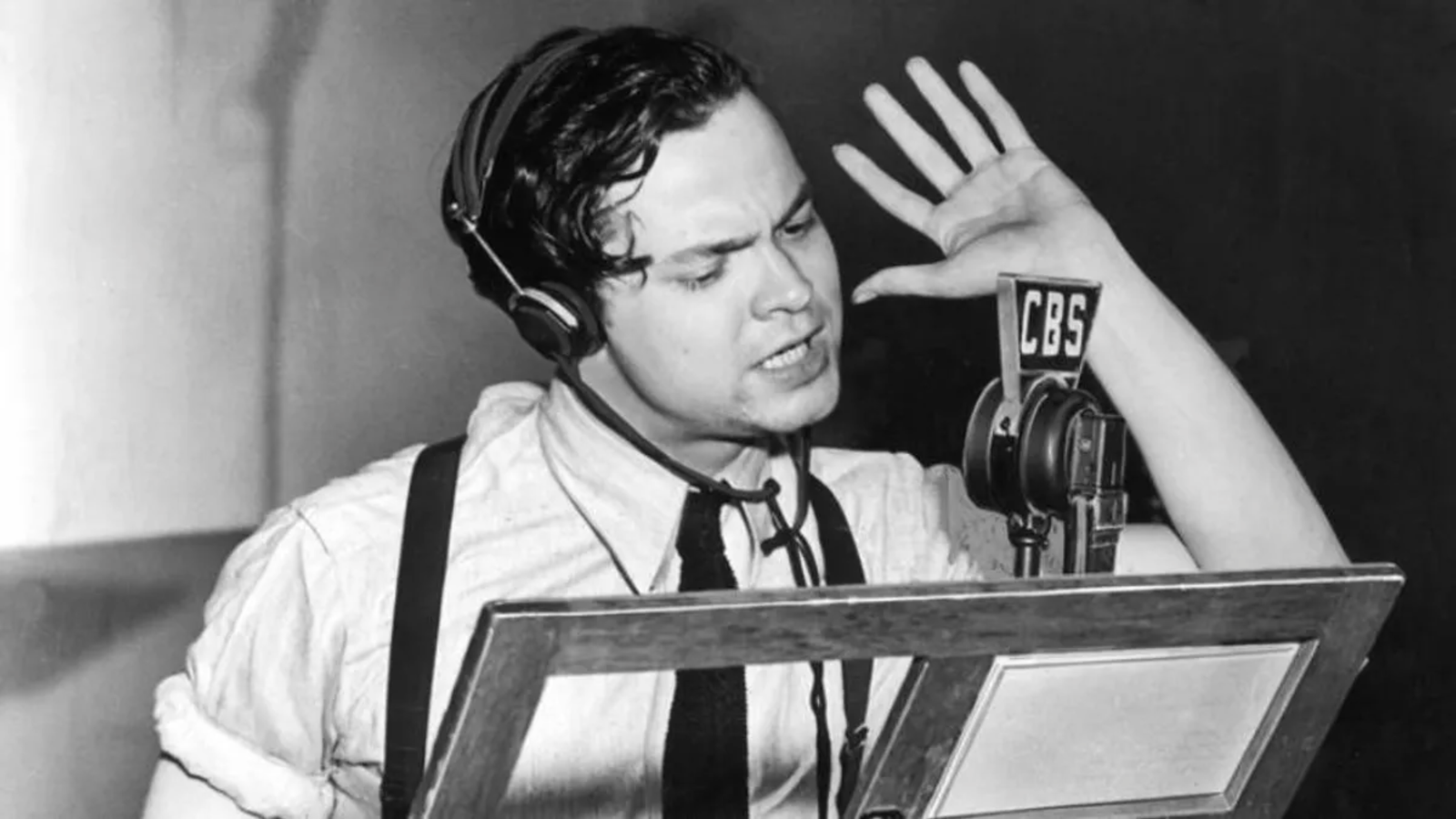
The intimacy of the new medium was immediate and unprecedented. FDR’s fireside chats put the president’s voice in your living room, like the two of you were friends. A man named Father Coughlin reached thirty million listeners with anti-Semitic conspiracy theories from a church in Royal Oak, Michigan. Orson Welles performed “War of the Worlds” in 1938. Then, newspapers, which were losing ad revenue to radio, fabricated a mass panic to discredit this new medium. So, the most famous story about media manipulation was itself media manipulation.
But here’s the biggest leap yet.
In 1946, there were 10,000 television sets in America. By 1950, nine percent of households had one. By 1955, sixty-four percent. By 1960, eighty-seven percent. Beyond entertainment and information, it was status. Or at least marketed and understood as such. No technology in history had colonized domestic space that fast. Fifty million people, having the same experience, at the same moment, in separate rooms. The greatest democratization of information in history. Also the most efficient synchronization of attention ever achieved.
If we’re putting a man on the moon, we better make sure it gets seen.
But the tv didn’t come without disillusionment. Even early on, in 1958, NBC’s Twenty-One, a game show, supplied quiz answers to the more favored contestants to keep the audience watching. Charles Van Doren, a Columbia instructor with, we’ll say, patrician looks, won $129,000 before a disgruntled former contestant testified. Van Doren confessed, was fired. It was one of the first signs that tv was just meant to deliver audiences to advertisers in the most emotionally receptive state possible.
On May 9, 1961, the reality of television’s impact had set in, and Newton Minow stood before the National Association of Broadcasters, inviting them to watch their own programming. He said, “You will observe a vast wasteland.” But the speech changed almost nothing. The vast wasteland was the thing that fifty million Americans chose to watch every night, and that choosing was, in its own way, genuine nonetheless.
Eventually though, the machine did not merely broadcast content. It decided who would become famous, and on what terms.
The Hollywood studio system put actors under seven-year contracts that controlled everything: their names, their weight, their romantic lives, their public image. Roy Harold Scherer Jr. became Rock Hudson. Norma Jeane Mortenson became Marilyn Monroe. Archie Leach became Cary Grant. Those were the conditions. Rock Hudson’s agent Henry Willson arranged Hudson’s marriage to Phyllis Gates to suppress his homosexuality, because a gay leading man was not a product the system could sell. Judy Garland was given amphetamines to keep her energy up and barbiturates to bring her down, managed by MGM like a piece of ornery machinery. The star was manufactured. The public believed they were discovering talent. They were consuming a product that had been designed, tested, and packaged before it reached them.
It’s easy to mistake this as some kind of malicious conspiracy. That’s not quite right though. In a capitalist system, if it doesn’t make money then it just can’t exist. The end.
If the audience wouldn’t have turned their (our) noses up at a gay Rock Hudson, then we might’ve had one.
You can have a straight Rock or no Rock. Is that the choice we face?
You can have a CEO with ludicrous pay or you can have a CEO who leaves for the competition.
You can have a job at the Nylon factory whose ads gave your wife bulimia, or you can lose that job, start your own company, and have a happy wife with bare legs.
Is that how this all works? On the flip side, you can take the money away, become socialist, and watch nothing remarkable happen. That can’t be the solution.
Hence why they say capitalism is unfortunately the best thing we came up with so far.
This business clearly doesn’t come without casualties, and many of which come with highly dubious pretenses.
You can see it in the music industry. Billboard maintained a separate chart for Black musicians called “Race Records” until 1949, when it was renamed “Rhythm and Blues,” a rebranding that changed nothing about the segregation of radio playlists. Pat Boone recorded sanitized covers of Little Richard and Fats Domino songs for white audiences, as the marketable audiences, and the covers charted higher than the originals because the distribution system found white artists to sell better.
Record labels paid radio DJs to play their songs, irrespective of the racial background, so more records would sell. That’s easy to understand. But Alan Freed, the white DJ who coined the term “rock and roll” and played Black music for integrated audiences, took money from both sides but got destroyed in the payola investigations of 1959. The more established record companies overpowered him, claiming he was taking bribes to promote black music even when everyone was getting paid to promote all kinds of music. Of course, the ones who made their money historically from white music, the most powerful ones, stood to lose profits if black music gained popularity. So, Freed was fired from WABC, indicted for commercial bribery, and died at 43 years old. Dick Clark, who had done essentially the same thing, survived by divesting his music publishing interests before testifying to Congress.
What should the established record labels have done in that situation? Invest in black music rather than try to squash it? Why wouldn’t they have?
Is it that the audience won’t buy it? That the executive think the audience won’t buy it? That the executives don’t want the audience to want it? Maybe sometime but not right now? Are they protecting their back catalog from potential market cannibalization? Is it a chicken? An egg?
In the end, the only color that matters is green.
So, Berry Gordy at Motown got clever. He hired Maxine Powell to run an “artist development” program, a finishing school where the Supremes and the Temptations learned etiquette, stage presence, how to walk, talk, eat, and dress. Cholly Atkins taught the choreography. The explicit goal with all this was making Black artists palatable to white mainstream audiences and television appearances. It was a big success. Who doesn’t love that music? But what might’ve been otherwise?
Well that’s more like Nina Simone, who refused the finishing school and spent her last decades in exile. Same era, comparable talent, opposite relationship to the machine. The Supremes had twelve number-one singles. Simone never had a single one.
Ok music, sure. One more note on Hollywood though. On November 22, 1968, Star Trek aired the first interracial kiss on American network television. NBC was nervous and asked for alternate takes without the kiss. William Shatner deliberately ruined the non-kiss takes so the network had no choice but to air the real one.
Politics quickly and blatantly swept through Tinseltown. In 1947, the House Un-American Activities Committee called the Hollywood Ten to testify about Communist affiliations. They refused. They were cited for contempt, imprisoned, and blacklisted. One of the highest-paid screenwriters in Hollywood, Dalton Trumbo, could not work under his own name for over a decade. He wrote screenplays under pseudonyms, winning an Academy Award for “The Brave One” in 1956 under the name Robert Rich. The system, now with government involvement, decided which stories were told, which artists told them, and which ideas were permissible. The audience experienced this as choice.
The visible machinery of broadcasting and studios was only the surface, and most people learned about them decades later, if ever.
The CIA’s Operation Mockingbird, which began in the early 1950s under Frank Wisner, placed assets inside major American news organizations. For example, Carl Bernstein’s 1977 investigation for Rolling Stone documented approximately 400 American journalists who had carried out assignments for the CIA, including correspondents at the Washington Post, the New York Times, CBS, and Newsweek. The agency placed cooperative people inside existing institutions to fabricate their stories to shift the paradigm and the zeitgeist.
And how about the arts?
The Congress for Cultural Freedom, founded in 1950, was a CIA front that funded literary magazines across Europe and America, promoting abstract expressionism as a symbol of American creative freedom against Soviet socialist realism. It was art criticism as Cold War strategy. The public, including the artists and writers themselves, found out about the bankrolling in 1966, but in the end, it changed nothing about the art, which remained extraordinary. However, it changed everything about what “independent culture” means inside an empire.
The arts are one thing, but this all started extending into serious weaponization and quickly.
The FBI’s COINTELPRO, running from 1956 to 1971, turned media against domestic targets. On November 21, 1964, the FBI sent an anonymous letter to Martin Luther King Jr., calling him “an evil, abnormal beast” and writing: “You are done. There is but one way out for you.”
The Pentagon’s entertainment liaison office even operates openly, offering Hollywood access to military equipment in exchange for script approval. For instance, Top Gun (1986) was produced with full Navy cooperation, and recruitment into blood and bullets surged 500 percent. Yet, even today, most audiences do not know this arrangement exists.
The thing about ideas is that they don’t all need Tom Cruise. Some ideas are cheap.
In 1967, the Sugar Research Foundation paid three Harvard scientists approximately $6,500 to publish a review in the New England Journal of Medicine that shifted blame for heart disease from sugar to fat. That review shaped American nutritional policy for decades.
This sums it up pretty well. A tobacco industry memo from Brown & Williamson, written in 1969, stated the principle: “Doubt is our product, since it is the best means of competing with the body of fact that exists in the mind of the general public.”
Turns out, persuasion is pretty straightforward. It’s way easier to fabricate reality than it is to actually create it.
Think of the main principles you see time and time again.
Repetition. The illusory truth effect, demonstrated in 1977: repeated statements are judged more true regardless of accuracy. “Just Do It” means nothing. You can hear it right now because you have heard it ten thousand times, and the ten thousand repetitions make an argument.. for…. something important, right?
Framing. You never change what people think; you change the frame they think inside. “Death tax” and “estate tax” describe the same policy. Support for repeal shifted from 70 to 80 percent when the name changed.
Fear. Identify an invisible threat. Place it inside the community. Watch the community reorganize around surveillance and exclusion. Salem. McCarthy. Coughlin.
Narrative control. Joseph Campbell described the hero’s journey in 1949. Christopher Vogler translated it into a Disney studio memo in 1985. If you control the story structure, you control what feels like a satisfying ending, and therefore control what people want. In a moment and in a lifetime.
Intermittent reinforcement. B.F. Skinner’s variable-ratio schedule: one pellet per unpredictable number of lever presses. The most addictive reward pattern known to psychology. Slot machines operate on this. So does every notification on your phone.
Parasocial intimacy. Horton and Wohl coined the term in 1956: one-directional emotional bonds between audiences and performers. The radio host who feels like your friend. The YouTuber who looks into the black empty lens and says “Hey guys.”
Identity attachment. You do not sell the product. You sell the kind of person who buys the product. You don’t buy a Harley; you become a Harley rider. Apple did not sell a computer. It sold the idea of being someone who uses a Mac. J. Walter Thompson, one of the biggest ad agencies in America, hired the behavioral psychologist John B. Watson in 1920 to figure out how to sell more soap. Watson’s answer: stop making rational arguments. Instead, trigger fear (your skin will age), greed (you could look like her), and the need to belong (everyone is already using this). It worked. The same technique that sold Ponds cold cream in 1921 sells political candidates today.
At the granular level, these principles are everywhere. Victor Gruen designed the first enclosed shopping mall in 1956 with no windows, no clocks, disorienting layouts; the moment when a purposeful shopper becomes an aimless browser is still called the Gruen Transfer, and Gruen was horrified by what malls became. And casinos. And offices. The tabloids and sugar sweets at the checkout lane aren’t just there because there was nowhere else to put them, right? A car dealer asks your budget before showing you anything, and the number you say becomes the anchor around which every price orbits. A dating app delivers matches on a variable schedule because a predictable reward is less compelling than a surprising one. The checkout page counts down “Only 2 left at this price,” whether or not this is true, because scarcity bypasses deliberation in the brain.
In 2004, neuroscientist Read Montague put subjects in an fMRI scanner and gave them Pepsi and Coke in blind taste tests. Their brains preferred Pepsi. Then he told them which cup was Coke. Their brains switched. The brand did not change their preference. It changed their experience. The pleasure was neurologically different because of the label on the cup.
This is how influence works. It’s easy.
So, is anyone in charge?
The satisfying answer would be a name, an address, a shadowy room. The accurate answer is nobody. And that is precisely what makes the system work.
Noam Chomsky and Edward Herman published Manufacturing Consent in 1988 and described five filters: concentrated corporate ownership, dependence on advertising revenue, reliance on official sources, institutional punishment for dissent, and a disciplining ideology. “The mass media serve as a system for communicating messages and symbols to the general populace,” they wrote. “It is a ‘de facto’ propaganda system.”
The critical word is “system.” The five filters do not require a meeting. Media companies benefit from large audiences. Advertisers benefit from receptive consumers. Political institutions benefit from a managed population. Technology platforms benefit from engagement, which correlates with emotional intensity, which correlates with outrage and desire. Everyone is acting in rational self-interest.
The result is a system that functions as though it were designed by a single intelligence, but was designed by no one. A conspiracy can be exposed and dismantled. A system of converging incentives cannot. There is nobody to overthrow.
The 21st century brought something altogether different.
Facebook launched its News Feed in September 2006, and it spread to billions. The algorithm optimized for engagement. Engagement optimized for outrage and desire. Tim Wu called this “the grand bargain”: free content in exchange for attention, attention and opinion meticulously cultivated and curated and sold to advertisers. Keeping the money moving.
So, what might have been, without the machine?
Dalton Trumbo could not write under his own name for a decade. Paul Robeson, one of the most gifted performers of the twentieth century, had his passport revoked in 1950 for his political views. His recordings were removed from stores. The system did not merely silence him; it erased the evidence that he had ever been loud. How many songs were never recorded because the artist could not access the studio? How many films were never made because the person who would have made them understood the cost?
The sugar industry’s payment to Harvard shaped American diet for forty years. The tobacco industry’s doubt campaign delayed public health action for a generation. The CIA’s cultural programs shaped what “independent art” looked like across an entire continent. What music would have charted if the playlists hadn’t been segregated? What would democracy look like if Operation Mockingbird had never placed a single asset in a single newsroom?
The losses are real and incalculable. You cannot mourn a song that was never recorded, a film that was never made, a voice that was never heard. You can only notice the silence and wonder what would have filled it.
The twentieth century produced three intellectual responses to all of this.
Modernism tried to build art outside the system. Joyce disassembled the novel. Picasso disassembled the image. The Dadaists performed anti-art in galleries. “Make it new,” Pound said. They had conviction. Originality could refuse the market! The machinery absorbed every piece of it. Duchamp’s urinal is in a museum. The museum charges admission. The gift shop sells postcards.
Postmodernism drew a logical conclusion. If there is no outside the system, irony is the only honest posture. Warhol silk-screened soup cans and brillo boxes. David Foster Wallace, in “E Unibus Pluram” (1993), identified the terminal stage of all this; television had absorbed irony as a defense mechanism. Commercials mocked advertising. Sitcoms winked at their own conventions. “Irony’s become our environment’s default mode,” Wallace wrote. The medium had eaten its own critique and was selling tickets.
Mark Fisher, in Capitalist Realism (2009), named the condition: “It is easier to imagine the end of the world than the end of capitalism.” Awareness is a room inside the machine, furnished with books and critical theory, with a door that opens inward. George Orwell understood this from experience. He worked at the BBC from 1941 to 1943, producing propaganda from a basement office in a department store. Room 101 at Broadcasting House was a real conference room; he named the torture chamber in 1984 after it. He knew the machine because he helped build it.
Then, by the twenty-first century, the thinking and the sentiment began to evolve. Timotheus Vermeulen and Robin van den Akker called it metamodernism: an oscillation between sincerity and irony, between genuine belief and the knowledge that belief is constructed. Informed naivety. The modernist says: I will build something outside the system. The postmodernist says: there is nothing outside the system. The metamodernist says: I know there is nothing outside the system, and I am going to feel something real anyway, dammit. The question was always what kind of life could be lived inside the machine, as if we’re trapped in here.
And yet.
In 1957, Jerome Robbins choreographed a sequence for a musical about two street gangs in Manhattan. In the “America” number, the dancers’ bodies did something that should not have been possible: they expressed joy and anger and longing and sarcasm simultaneously, every gesture doing four things at once, feet hitting a rooftop in rhythms that carried the argument the lyrics were making while also carrying a counter-argument the lyrics were not. The music was Bernstein. The lyrics were Sondheim. Gang violence made transcendent. The audience wept. They are still weeping. The show has run for nearly seventy years because the beauty in it is real, is genuinely and irreducibly real, and no amount of knowing that the production was funded by investors and distributed by a Hollywood studio changes what happens in your chest when the dancers hit the roof.
On February 9, 1964, seventy-three million Americans watched the Beatles perform on the Ed Sullivan Show. Seventy-three million people heard the same chord at the same moment and something in the culture shifted permanently. Kids in basements in Ohio and kitchens in California and living rooms in Maine all heard it at once, and the ones who picked up guitars afterward did so because the sound moved them, genuinely moved them, in a way that had nothing to do with CBS’s advertising revenue and everything to do with what four guys from Liverpool could do with two guitars, a bass, and a drum kit.
Gabriel Garcia Marquez began writing One Hundred Years of Solitude in July 1965. He went into his study in Mexico City, which friends called “the Cave of the Mafia,” and did not come out for fourteen months. His wife Mercedes pawned their household appliances to keep the family fed. She pawned the typewriter. Their debt reached ten thousand dollars. When he finished the 1,300-page manuscript he wrote to Carlos Fuentes: “It turned out better than I expected.” It had. The novel is one of the most beautiful things a human being has ever made. Fifty million people have read it. The man who wrote it had spent years working in advertising, and his masterpiece reached the world through the same publishing apparatus as everything else in this story, and none of that diminishes a single sentence.
On a Sunday night in July 1969, six hundred million people watched Neil Armstrong step onto the moon. They watched on the same televisions that delivered the vast wasteland, through the same networks, surrounded by the same furniture. And when Armstrong’s boot touched the surface, six hundred million people held their breath at the same time, and the breath was real, and the awe was real, and the collective experience of wonder was made possible by the same broadcast infrastructure that sold soap and rigged quiz shows and synchronized a nation’s attention for profit.
There is a song you heard once, in a car or a kitchen or through a pair of headphones on a bus, that changed the way you understood your own life. There is a film that made you see something you had not seen before. There is a book that arrived at exactly the right moment, as though someone had sent it. Every one of these reached you through a system built to manage your attention. And every one of them was real. The feeling happened inside the system, the way the kiss happened inside the drive-in, the way the painting happened inside the cave.
Now back up.
It’s 1957. The movie is still playing. The projector is still broken on the left side. The speaker still crackles. A moth throws a bird-sized shadow across the plywood wall of the concession stand.
The machine that built this evening is still operating. It has always been operating. It was operating when Homer sang for his patron and when Bernays renamed propaganda and when the algorithm learned that outrage holds attention and when you picked up whatever device you’re reading this on.
And the evening is still perfect. That is the thing. The machine is real, and the evening is also real, and you’re not any less real because of it. The boy will remember the blue light on the roof of the car and the way he felt in that moment for the rest of his life. The girl will remember that the speaker was broken and her heart was beating too fast to care.
The night air is cool on their skin. The light moves in slow blue waves. Somewhere the popcorn machine hums. Somewhere the other radios leak through closed windows, playing songs that someone, once, in a room, wrote for a buck.
In ten years, the boy will own a small business and take out ads in the local paper. The girl will become a teacher who shows filmstrips produced by companies she has never heard of. They will both operate small, ordinary pieces of the machine, and they will have hundreds more nights like this one, each of them warm and imperfect and unrepeatable, and every single one of them will be real.
They lean back against the bench seat and breathe out. Blue light pools on the ceiling of the Chevy, slow as water. One window down. The whole summer is out there.